mappa classificazione strade e piste ciclabili in Germany: guida alle D-Routes e alla rete tedesca
D stands for Germany and the D routes for an extensive cycle network that criss-crosses the country. Relaxed cycling on Germany's long-distance cycle routes Not least since the boom in e-bikes, more and more people are discovering cycling as a sporty and enjoyable form of holiday. No wonder, since everyone can decide for themselves how fast they want to go. When it comes to deciding where to go, the German Cycle Network (Radnetz Deutschland) with its 14 long-distance cycle routes is a huge help, as they are something like the main arteries, guidelines and narrative threads in the German long-distance cycle route network.
In fact, the cycle routes, each several hundred kilometres long - totalling around 12,000 kilometres - connect a whole range of regions, landscape types and cultural areas. So when you set off on a D-route, you're not just travelling from A to B, but right into the heart of German history and travel culture.
What they all have in common is that they are often designed to enable even less experienced cyclists to make pleasant progress. This is due not only to the uniform signage, but also to the good maintenance of the paths and the fact that many sections run along cycle-friendly side roads such as former railway lines or even specially constructed cycle paths. Ideal for setting off with light luggage and heading calmly to the next cycle-friendly accommodation, whether booked or not.
It is practical that a corresponding infrastructure has long been established along the route. This also includes holiday apartments, farms and campsites.
Three cheers for spontaneity! This diversity also applies to the character of the routes: some follow rivers, others old trade routes or coastlines. Some offer open landscapes, moors and wide fields, while others lead through more densely populated regions, including eye-catching examples of industrial culture and modern urban architecture.
But everywhere you go, there are little moments of delight waiting for you: bakeries smelling of fresh bread rolls, hidden swimming spots, rest areas with sweeping views, vineyards or beer gardens where you might ask yourself: should I keep cycling or keep drinking, perhaps a second shandy?
How fortunate that there are usually plenty of train stations along the routes, because then you can hop on the train instead of pedalling - and that doesn't just apply to spontaneous early finishes. At least for one or two stages.
Good to know: Germany's cycle network currently consists of 13 D-routes plus the German Unity Cycle Route. On D-Route 3, the Europaradweg, which runs across the country from the Dutch to the Polish border, cyclists roll through a panorama of green meadows, lively towns and quiet forests.
The more southerly Mittelland Route (D-Route 4), one of the main axes of the German cycle network, also connects west and east. However, the low mountain ranges mean that there are a few more metres of elevation gain on the way from Aachen to Zittau. On the other hand, there are significantly fewer on the D-Route 2, which winds its way along the Baltic Sea coast.
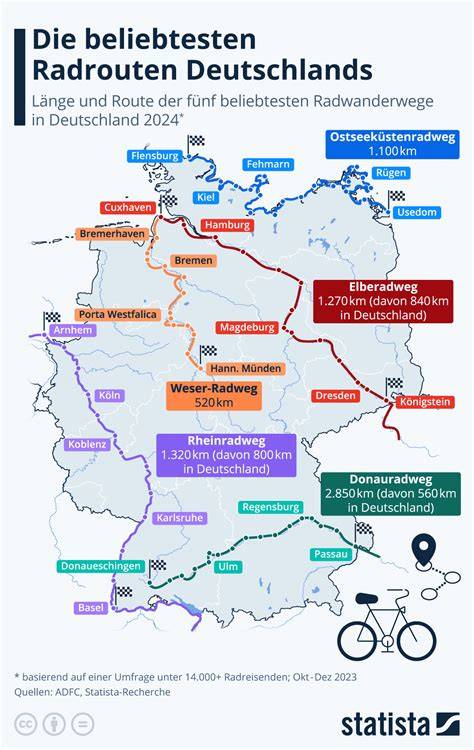
Would you rather hear stories about rivers? As one of the longest and best-known routes in the German cycle network, D-Route 8 runs along the Rhine. If you want to cycle the entire route from the Lower Rhine to Lake Constance, which is rich in castles and wine, you will need to allow a little more time. The route is 1,230 kilometres long.
Not quite as long, but also mostly running along the river, is the D-Route 6, where the D could also stand for Danube. Several rivers - the Saar, Moselle, Rhine and Main - accompany the D-Route 5 (Saar-Moselle-Main). It owes its nickname ‘connoisseur's route’ to the rare inclines and the culinary specialities and wines that tempt you along the way.
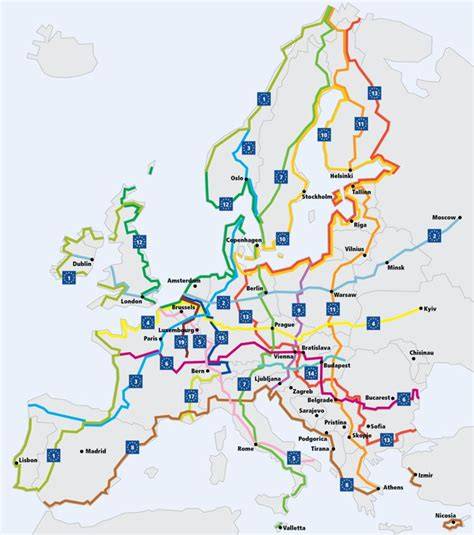
The D-Route 7 is also interesting. This historic pilgrimage route allows you to explore important religious sites in Germany and Europe by bike. Europe? Yes, because the route continues on to Denmark, Belgium and the Netherlands. And this is no exception: almost all D-routes are well integrated into the EuroVelo network.
This means that tireless cyclists can not only overcome their own physical limits, but also cross national borders with ease. The route continues in a similarly cycle-friendly manner towards the Atlantic, the Mediterranean or the Baltic States.
Feel the salty breeze, hear the sound of the waves and experience the endless expanse of the Wadden Sea - D-route 1 runs for over 900 kilometres from the Danish to the Dutch border along one of Germany's most impressive landscapes. D-route 2 runs for around 1,100 kilometres from the picturesque island of Usedom in the east to the Danish border near Flensburg in the north - always along the Baltic Sea coast.
Along the way, it passes dream beaches, historic Hanseatic cities, bustling ports and protected nature reserves. From the Dutch border to the Oder River - D-route 3 offers an epic east-west crossing of Germany. D-route 5 runs from Saargemünd on the French border to Schirnding in Upper Franconia - always along the Saar, Moselle, Rhine and Main rivers.
D-route 6 runs right across southern Germany - from Weil am Rhein on the border with France and Switzerland to the Austrian border at Jochenstein. The pilgrimage route runs from south to north through north-western Germany. A trip along D-route 9 is a cross-section of western Germany: covering almost 1,300 kilometres, it leads from Bremerhaven on the North Sea coast to Füssen at the foot of the Alps.
D-route 10 follows the course of the Elbe for over 850 kilometres - from Cuxhaven on the North Sea to Bad Schandau on the German-Czech border in the Elbe Sandstone Mountains. The route is almost entirely flat and is suitable for leisurely cycling as well as for sporting challenges. Along the way, a varied landscape with impressive flora and fauna awaits: in natural Elbe meadows, dreamy floodplain forests and in front of spectacular rock formations, you can observe sea eagles, cranes and storks.
D-route 11 is just under 1,600 kilometres long and crosses the eastern part of Germany from north to south. In the far east of Germany, the Oder-Neiße Cycle Route runs from Zittau on the border with the Czech Republic to the island of Usedom in the Baltic Sea.
For long stretches, it follows the course of the two rivers that form the border with Poland. At just under 600 kilometres, D-route 12 is the shortest route in the German Cycle Network. The Iron Curtain Trail - ICT for short - follows EuroVelo 13 along the former border between the Warsaw Pact countries and Western European countries. In Germany, the cycle route crosses state borders and follows the course of the former Iron Curtain.
It invites cyclists to explore and experience this historic part of the continent. The German Unity Cycle Route connects Bonn and Berlin as historic start and destination locations, enriching the cycle route network in Germany with a new, attractive offer.
Germany is one of the best countries in Europe for cycling tourism when it comes to route preparation. A dense network of marked and well-maintained paths, diverse landscapes - from mountains to coasts - and excellent infrastructure for cyclists make cycling a pure pleasure. Many routes run along rivers, through national parks, picturesque villages, and cities with rich history.
It's important to note that cyclists are taken seriously here - they have their own lanes, parking spaces, charging stations for e-bikes, and special services. Bicycle culture is excellently developed in Germany. The bicycle is a popular means of transport to work or school.
In large cities, you often see parents taking their children to school and kindergarten with specially adapted cargo bikes. Year by year, the popularity of e-bikes is also growing, allowing older people or beginners to cover longer distances. The cycling paths are excellently marked, safe, and comfortable.
It can be said with certainty that Germany is an ideal destination for a cycling tour, and thanks to its proximity to Poland, we can quickly reach our dream route via highway or train. Below, we present an overview of the 10 most interesting cycling routes in Germany, as well as the most important information for cyclists who want to spend time across our western border.
Bivouacking and wild camping - freedom with limitations Unfortunately, wild camping in Germany is generally prohibited - both with tents and motorhomes. Federal law, as well as state and local regulations, control this very strictly, especially in national parks, nature reserves, and private forests. Sometimes so-called "emergency bivouac" is possible - setting up a tent for just one night, without fire and waste, far away from the paths - but this is a balancing act on the edge of legality.
It's better to use the numerous campsites, many of which are located directly on cycling routes and offer amenities for cyclists, such as places to dry clothes, lockable bike boxes, or outlets for charging e-bikes.
Law and cyclists in Germany In general, road traffic law for cyclists is uniform throughout Germany - it's regulated by the Road Traffic Regulations (StVO). But how strictly the regulations are enforced can vary locally. For example, in Bavaria, known for its love of order, you may actually more frequently face penalties for riding without lights, ignoring traffic lights, or riding on the sidewalk.
In practice, you should stick to basic rules: use lights, follow traffic signs, don't cross pedestrian crossings on your bike, and don't ride under the influence of alcohol (the limit is 1.6 per mille, but already from 0.3 you can have problems in case of an accident).
How to get to Germany with a bicycle? The most comfortable option is the train - both regional connections from Poland to Germany and international intercity trains. However, it's worth checking in advance whether bicycle spaces need to be reserved - this is usually required on long-distance trains.
An alternative is the car with a bicycle rack or a bus that transports bicycles (there are also companies specialized in transporting bicycles to Germany, especially for larger groups). International buses usually don't transport bicycles or do so for an additional fee and to a limited extent.
Bring your own bike or rent one? If you can't bring your own bicycle, bike rental stations in Germany are a good option - they're modern and well-equipped. They offer not only classic trekking and mountain bikes but also e-bikes, cargo bikes, or trailers for children. Many of them also rent panniers, helmets, tools, or child seats. Prices start at about 10-15 euros per day for a regular city bike, an e-bike costs about 25-35 euros daily.
You'll find bike rental stations in large cities, on main cycling routes, and even at train stations (e.g., the DB Rad+ or Nextbike network).
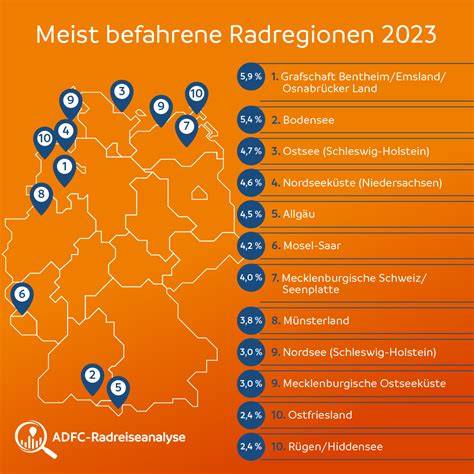
ADFC: German Bicycle Club It's also good to know what the ADFC is - the General German Bicycle Club. This is the largest bicycle organization in Germany, which has been working for years to improve infrastructure and safety and promote cycling tourism. The ADFC publishes an annual analysis of the most popular cycling routes (ADFC-Radreiseanalyse), creates detailed maps, guides, and certifies routes according to quality criteria.
If you're planning a tour through Germany, following the ADFC recommendations guarantees that you'll encounter well-prepared, tested, and bicycle-friendly paths - with the appropriate surface, signage, and infrastructure.
What does a one-week cycling tour through Germany cost? The cost of the trip depends on the travel style. For a budget tour: Transport: Train from Poland to Germany and back with bicycle - approx. 300-400 PLN, depending on the departure location Accommodation: Tent sites or campsites - from as little as 10-20 euros/night Food: Self-catering and occasional local restaurants - 20-30 euros daily Other: possible admission fees, ferries, bicycle service - approx. 50 euros per week
If you want to minimize costs and can bring a camping stove, you can complete the entire one-week trip for approx. 1500-2000 PLN. If you dream of a cycling adventure through a country of castles, rivers, and wine hills - Germany has everything you need.
Traveling by bicycle through Germany, you can enjoy excellently developed cycling infrastructure and admire a true range of landscapes: from the rushing waves of the North Sea to the Alpine views of Bavaria.
In this section, you'll find routes that the German Cycling Club (ADFC) recognized as the most popular in 2024. The Elberadweg route is in second place in the ADFC poll - but due to its proximity to the Polish border, we've placed it in the list below, among routes near Poland.
Most of these routes have been at the top of the ADFC poll for many years.
Esempi di percorsi D principali e descrizioni rapide
1. Weser-Radweg: il più popolare, inizia nello Weserbergland e attraversa le pianure della Bassa Sassonia fino al mare di Wadden, con soste a Bad Karlshafen, Corvey e Portа Westfalica.
2. Danubio: anche se noto come Danube Cycle Path, offre viste memorabili dall'Upper Danube Nature Park a Blautopf e Regensburg, fino a Passau.
3. D-Route 8 (Reno): lungo il Reno, tra Mainz e Colonia, con castelli e siti storici lungo la valle.
4. Mosella-Radweg: lungo la Mosella, con vigneti, Trier, Neumagen-Dhron e Castelli lungo le colline.
5. D-Route 11: percorso lungo la costa baltica e prosegue verso Berlino, con diramazioni su Roer e Saale.
il PERCORSO CICLABILE più bello d'ITALIA
La rete europea EuroVelo è spesso integrata nei D-routes, facilitando viaggi transfrontalieri verso l'Atlantico, il Mediterraneo o il Mar Baltico.
L’Elberadweg, l’Elba e il Danubio sono esempi emblematici di come i percorsi long-distance tedeschi uniscono natura, città storiche e infrastrutture moderne.
L’ADFC e BALM: attori chiave della promozione ciclistica. L’ADFC gestisce la certificazione di qualità, le analisi annuali e la promozione del turismo in bicicletta; BALM coordina il sostegno finanziario e l'organizzazione di rete.
Statistiche e infrastrutture: oltre 320 itinerari, più di 44 percorsi di qualità all'interno della Germania, oltre 2 all’estero e 6 regioni turistiche per biciclette con marchio ADFC.
Per chi desidera pianificare un viaggio: servizi di alloggio mirati ai ciclisti, GPX scaricabili, guide e mappe dettagliate sono disponibili attraverso le reti di ADFC, BALM e bed+bike.
In sintesi, la Germania offre una rete stradale ciclistica classificata in D-Route che attraversa paesaggi variegati, collegando regioni storiche e geografiche con infrastrutture moderne e una cultura della bicicletta ben radicata.