
Arm tremolo Kahler fulcrum: descrizione, varianti e utilizzo su chitarre e bassi
Arm with no tip for Kahler fulcrum style bridges, 1/4 inch diameter. Choose the color, length, and hand. Made from stainless steel, the gold is plating, the black is powder coating and the stainless is hand polished to a shine. Fits Kahler 2500/2520 Traditional, 2710 Killer, 2720 Spyder and the 2760 Steeler models. Can also be used on Kahler bass tremolos if you prefer a shorter arm. You may have to read this twice - Kahler coming up with a fulcrum-type tremolo? Wasn't Kahler's Empire built on the antithesis of the fulcrum principal?
Contesto e percezione storica
The first point is the fact that the new system is a direct retrofit for a standard Strat trem, absolutely no routing. The fulcrum comes in two models - the Standard 2520 and the Pro 2500, although at present only the economy Standard is available in the UK. The economy Standard? It must be said that with such a retail price this isn't a typical high quality Kahler unit, certainly the machining and plating, in this case chrome - black chrome is also offered - isn't the best I've seen.
Caratteristiche principali del sistema
It is a weighty hard cast alloy block, the spring system is the same as a Strat although the fulcrum is achieved via two hefty screws which locate into the front edge of the block. These fit into the outer holes of a Strat-type assembly, although being of a larger diameter the existing holes must be enlarged. It is the saddles that are the really neat bit of the bridge. Each one has a brass roller and is adjustable for intonation in the usual manner via two grub screws. At the back of the bridge are the fine tuners, placed in the same lateral plane as the strings. The string doesn't pass through the block in normal Strat fashion but enters the bridge through a hole in the fine tuning assembly, passes through a tube that connects to the saddle and pops up over the roller. The important point here is the break angle behind the roller which provides not only sustain but also attack of the picked note. Finally, each saddle can be locked individually in place via an Allen-keyed bolt that passes up from the back of the base into the bottom of the saddle. This may seem a bit fiddly but it isn't in practice. The bolt is simply loosened allowing height and intonation to be set.
Montaggio e configurazione
The trem arm screws into the bridge in the usual position, and is thick, long and well shaped providing the all important lever. Of course a locking nut is provided and fitted in the usual very awkward manner, especially on a Strat where the curve behind the nut makes positioning very frustrating. It was recommended to me that I positioned the locking nut and held it in place with a couple of dabs of superglue while I marked the four screw holes. Because the unit works in a similar manner to a Strat trem, setting it up isn't too difficult. Obviously you must allow a few turns on the fine tuners so that flat and sharp adjustments can be made and don't forget to stretch the strings before clamping down the locking nut. The locking nut slightly sharpens the strings when tightened so you have to compensate for this by slightly de-tuning before you clamp up.
But does it work? Well initially there were a couple of problems. When I'd tuned up and clamped down the locking nut a few hefty waggles sharpened the G string a perfect semi-tone on return to pitch - not too handy. I checked the nut grooves for dirt and polished them with a piece of 1200 wet and dry paper, then added some soft graphite. The problem seemed worse! Checking the bridge assembly I found that the G roller saddle was sticking so I applied some 3-in-1 oil for good measure. Still no joy. I also noticed that the 'G' was going flat when I did a standard string bend. Totally at the end of my tether I remembered some advice Dave Gladden had given me to check if the locking nut was doing its job. Simply ping the spring behind the nut, bend the trem down and if the pitch drops the nut's not working. Sure enough this was the problem. I took out the tension screws and lubricated the thread. By over tightening these screws I found that they did have a couple more turns, so something was blocking the thread. The result? Almost perfect tuning stability.
Conclusione sull'affidabilità e l'uso
It would seem that having no bridge saddle lock on each string is a contributory factor to the slight tuning instability as the rest of the system does work very well. If you only use medium-type bends as opposed to crazy waggling then the fulcrum trem works fine and holds its tuning. I spent quite a few hours getting this system to its near perfect state, not helped by the total lack of fitting and adjustment info. From the people that make possible the ultimate trem system the fulcrum trem comes as a bit of a let down. It's not that it doesn't work or anything, just that one expects so much from the Kahler name in terms of quality. So what have we here? A locking trem on the fulcrum principle, fine-tuners and a good action and feel that almost works perfectly (if any system can). The fact that this system is about a third of the price of a Pro cam system illustrates the dilemma - it looks and works according to the price.
Note tecniche e compatibilità
Arm with no tip for Kahler fulcrum style bridges, 1/4 inch diameter. Choose the color, length, and hand. Made from stainless steel, the gold is plating, the black is powder coating and the stainless is hand polished to a shine. Fits Kahler 2500/2520 Traditional, 2710 Killer, 2720 Spyder and the 2760 Steeler models. Can also be used on Kahler bass tremolos if you prefer a shorter arm.
- Armatura in acciaio inox, finitura disponibile in oro placcato, nero forno o lucido naturale.
- Diametro 1/4 di pollice, lunghezze e versi disponibili per mani destra o sinistra.
- Idoneità: Kahler 2500/2520 Traditional, 2710 Killer, 2720 Spyder, 2760 Steeler; possibile anche su tremolo bassi Kahler.
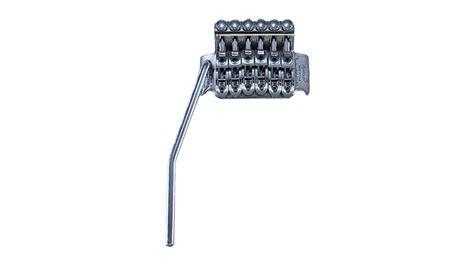
La soluzione di retrofit è diretta per un tremolo Strat standard, senza ulteriori lavorazioni. Il sistema di fulcro si presenta in due modelli, Standard 2520 e Pro 2500, con disponibilità attuale limitata al modello Standard economico nel Regno Unito. L'impostazione, pur richiedendo qualche cura, permette una sostituzione relativamente diretta rispetto a sistemi più complessi.
La parte centrale continua a offrire una buona azione e un feeling solido, anche se la percezione di qualità può variare rispetto agli standard Kahler più blasonati. La combinazione di un meccanismo di bloccaggio per ogni sella, la funzione di micro-regolazione e l'angolo di rottura dietro il roller contribuiscono a una risposta sonora che può fornire sustain e attacco senza compromessi, purché venga gestita con attenzione durante l'installazione e la messa a punto.